Mostrando postagens com marcador puzzle. Mostrar todas as postagens

segunda-feira, 13 de junho de 2022

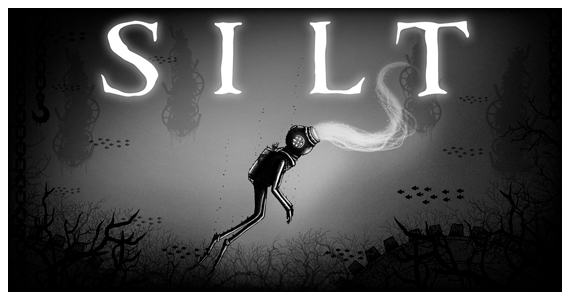
The mysterious (and dark) experience of SILT

Silt is, undoubtedly, the most interesting game I played this year. It is an exploration game set in a surreal oceanic void where you need to possess aquatic creatures around you with a strange soul energy to solve environmental puzzles and travel deeper into the darkness. The gaming objective is to face giant deep-sea goliaths and harness their power to awaken a long-dormant force at the core of the abyss.


The narrative is full of strangeness in a scenario full of old creatures’ statues, unexplored ruins, and ancient machinery. The monochromatic elements in the stages were created by the artist Mr. Mead (you can check his work here) and it is an awesome feature of the game. The sound design is also another point to highlight: in Silt there is no music, we experience a kind of a soundscape that follows our path into the abyss.


The narrative doesn’t deliver a full explanation about what is happening, who are you, why are you diving in this dark world. But it doesn’t matter. Silt invites us to be co-authors of its narrative. Following some ideas from Dansky (2007, p.5), it is possible to say that “On the most basic level, narrative strings together the events of the game, providing a framework and what can alternately be called a justification, a reason, or an excuse for the gameplay encounters. At its best, the narrative pulls the player forward through the experience, creating the desire to achieve the hero’s goals and, more importantly, see what happens next”. The blend between the mysterious narrative and the beautiful-grotesque scenario is an ideal approach to create immersion through the stages.



Spiral Circus, the studio behind Silt, made a piece of art and an excellent example of how important the gaming indie scene is for contemporary times. I’m finishing the third level and am already sad for the end of the game. One thing is certain: this is a game I’ll play more than one time.

#GoGamers
#GoSilt
#GoSpiralCircus


Reference:

DANSKY, Richard. Introduction to game narrative. BATEMAN, Chris (editor). Game Writing: narrative skills for videogames. Boston: Thomson, 2007.

domingo, 1 de setembro de 2019

A short analysis about Gorogoa’s puzzle experience

Definitely, the most interesting and thought-provoking game I’ve played this year was Gorogoa. I experienced the awesome puzzles in the screen of Nintendo Switch and, wow, that was mesmerizing. I followed the whole gaming creative process in social media, but the gameplay surprised me in an epic level.


It’s hard to describe the game in few words, but according to the definition from the official site, Gorogoa is “an ingenious, perfectly crafted puzzler”. The game creator, Jason Roberts, developed thousands of meticulously detailed hand-drawn illustrations, encompassing the impressive scope of Gorogoa's personal narrative.


Essentially, in the gameplay, you control four quadrants where you must execute a series of zoom in and zoom outs in the images to recombine shapes and create new physical possibilities and structure new scenarios from the most improbable objects. The video below explains the game’s main idea:


The great gameplay experience makes me want to write a personal short analysis of Gorogoa (for further consulting in classes) following a model proposed by Tracy Fullerton (2008) in her book Game design workshop.

• Players: single player game; one player against the puzzles
• Objectives: combine patterns to create and recreate scenarios/objects
• General rules: you can point and click in four different quadrants using zoom in and zoom out to connect new possibilities of images
• Resources: colorful images (hand drawn) with a fantasy theme disposed in four quadrants
• Conflicts: how good is your vision and imagination to solve the puzzles
• Limits: four quadrants with limited amount of zoom in/out possibilities
• Results: when you complete a puzzle correctly, the game shows you an animation and a new part of the scenario/narrative to point out your progress


Reference:

FULLERTON, Tracy, et al. Game design workshop: a playcentric approach to creating innovative games. Burlington: Morgan Kaufmann Publishers, 2008.

#GoGamers

quinta-feira, 6 de junho de 2019

Recreating classic puzzle mechanics in a very new shape

One of the most classic puzzle mechanics that we can find in games (specially in mobile games) is to push certain elements to the right places; sometimes the movements are limited, so we need to carefully study the challenge, sometimes we have unlimited movements, but usually get an element stuck in a place, so we need to start over again.


Push Maze Puzzle and Rebuild Chile are excellent examples of this gaming mechanics (by the way, the last one was used in a social campaign to earn donations for earthquake victims in Chile few years ago). Below, you can check out the gaming trailers to understand how this kind of puzzle game works:


This is a very traditional puzzle mechanic and, what we regularly see in many games, is the change of elements: sometimes we need to move rocks, other times we need to move boxes, plants, zombies, elephants and (fill the blanks).

However, recently I played one interesting game that caught my attention completely: Baba is You. The game has the simplicity of this previously discussed pushing mechanics, but you can interact with elements and words; when you interact with words, you can change the order of some phrases and affect game’s ecosystem and dynamics. Check the trailer below to understand this clever idea:


Baba is you reaches a new level of experimentation and recreation of a classic mechanic. This game is an excellent example of how we can (re)think something that, apparently, was exhausted in terms of innovation. By using words as a key to the puzzle design, Baba is you invites the player to use his mind in a creative way. On this subject, Koster (2005, p.152) reminds us that the “toughest puzzles are the ones that force the most self-experimentation. They are the ones that challenge us most deeply on many levels – mental stamina, mental agility, creativity, perseverance, physical endurance, and emotional self-abnegation”.

#GoGamers


Reference:

KOSTER, Raph. A theory of fun for game design. Arizona: Paraglyph Press, 2005.

quinta-feira, 17 de maio de 2018

MIND ALONE available for download

Today is a happy day for me. In a partnership with Sioux Studio (São Paulo) I’m launching my new mobile game named MIND ALONE.


I already wrote about this game here and now I’m presenting the final version, ready for download.

MIND ALONE is an experimental mobile game that uses puzzle mechanics to create a dark narrative about somebody trapped in their own mind. Each puzzle is a memory and the player needs to solve them to find hints about how it happened. Check the trailer below:


It’s the first game of a trilogy and it’s free for download on Apple and Android platforms.

We are just adjusting some puzzles – any feedback would be awesome.

One more for the portfolio and for the game designing classes!

#GoGamers

quinta-feira, 1 de dezembro de 2016

The Witness

Jonathan Blow is the game designer behind Braid, one awesome 2D platform game that uses time distortion as gameplay. In Braid, you can manipulate time to avoid death, solve puzzles, send a shadow to the future to perform an action, create “bubbles” of time lapse and many others cool mechanics. It’s one of my top 10 games. Check the trailer below:


In January of this year, Blow launched his new game: The Witness. Similar to Braid, it’s a puzzle game, but in a first person point of view. The mysterious narrative puts you in an abandoned and colorful island, full of digital screens. Each screen has a kind of an enigma that conducts you to the next one. Each puzzle solved gives you a small piece about the enigmatic history. You can check the main idea in the game’s trailer:


Points to highlight in the experience of the game:

1) Jonathan Blow recreates the classic mechanics of drawing a line through a labyrinth. Using colors, spatial restrictions, different shapes and logical reasoning, the game designer put the players’ mind to work, many times. The level of resolution of some puzzles is impressive.


2) The scenario is part of the narrative, and it works as a tool. Every single detail and object in the ambient contributes with the history. The island is full of statues and behind them there are hints for the plot. There are also some digital recorders with voices saying facts about the place. The colors of the trees, the direction of the light, the passing of time etc. everything could be an element for the story.

3) The game is full of references from movies, literature and other games. I found lots of similarities with Adolfo Bioy Casares’ “The Invention of Morel” book.

4) It’s a daring production. The Witness is a very artistic game. It explains little to the player and, most of the time, it’s essential to explore and use your mind to try to solve the puzzles.

I’m still playing the game, but the experience – till this moment – is strange, difficult and relaxing.

#GoGamers

segunda-feira, 29 de agosto de 2016

Eight steps for great puzzle designing

Scott Kim is a designer who creates puzzles for print media, websites and computer games. He is a big reference in this very specific field of ludic studies. Ernest Adams, in his book Fundamentals of Puzzle and Casual Game Design (2014), references Kim’s work talking about the “eight steps to create a good puzzle”. I want to highlight some ideas in these eight essential points.

1. Find inspiration: seems obvious, but it’s a nuclear part of the process. To solve lots of puzzles could be a great inspiration, but to search for ideas in other fields is another interesting way to create enigmas. Literature, movies, comics, toys and TV series are some examples of where to find inspiration.

2. Simplify: “keep it simple” is a mantra for game designers. After creating the main idea of a puzzle, it’s important to remove the excesses. Exploring the features of the platform (console, board game, mobile media etc.) can give you creative solutions for puzzle design.

3. Create a construction set: this third item is about prototypes and fast tests. With an idea on your mind, start to construct models (analogical or digital ones) and test this initial version. Test, test, test and test it again. Test alone and call other players to test.

4. Define the rules: Adams (2014, p.10) says that rules are “the key part of puzzle design. Most puzzles are characterized in terms of four things: the board (Is it a grid? A network? Is it regular? Or is there no board at all?), the pieces (How are they shaped? What pictures are on them? Where do they come from?), the moves (What is allowed and what is not? Are they sequential or simultaneous? What side effects do they have?), and the good or victory condition (Does it have to be an exact match, or will a partial one do?

5. Build the puzzles: when the mechanics is ready and functional it’s time to create the final version of the puzzle (analogical or digital). Here we need to pay attention to the first aesthetical details, information architecture and clear instructions for the player.

6. Test: is the final version done? Then test, test, test, and test it again. To find zero faults is difficult but it is always the desired outcome.

7. Devise a sequence: in a game with many puzzles - or many levels with puzzles – it’s good to create a logical order for them. Raising difficulty with some hints between the challenges is an interesting way to work the challenges of your game.

8. Pay attention to presentation: sounds, graphics and other details will make the difference in the puzzle experience. A good puzzle folded in a poor layout could be terrible for the players. Here, multidisciplinary work is essential.

Finally, it’s important to remember that, especially in digital games, puzzles can reach a new level of challenge using some impossible features or breaking the laws of physics. But in analogic games it’s possible to find interesting solutions, like in the “Codex Silenda”, a wooden book that compels you to solve puzzles to turn the pages.


In the video below, the designer behind the idea shows us a little bit of his creative process for this product.


#GoGamers


Reference:

ADAMS, Ernest. Fundamentals of Puzzle and Casual Game Design. San Francisco: Pearson, 2014.

terça-feira, 10 de fevereiro de 2015

The Swapper: a good game to observe puzzle mechanics

The Swapper is my new favourite entertainment. The game is a puzzle-platformer developed in 2014 by Facepalm Games, a small Finnish independent studio.

The game has awesome features allied to the puzzle mechanics and it's possible to see a perfect balance between narrative, scenario, mechanics and interface. Let's talk about each one of them.


The narrative is about a space traveller trying to get out of a mysterious abandoned space station. The dark scenario is perfect and there's an aura of fear and anxiety all the time.

The game operates in a side scrolling 2D and this choice of interface is determinant for the puzzle development.

The game mechanics is very clever. Your space explorer has a clone weapon and it's possible to "launch" a clone of your character in an unachievable part of the scenario to complete a puzzle. Check a video below:


Another weapon allows transferring your conscience to the clone to finish the puzzles. The Swapper is a good exercise of level and puzzle design to observe.

The main idea of the game is to collect some orbs to open panels and try to runaway from the space station.

Fullerton says (2008, p.324) that puzzles are also a key element in creating conflict in almost all single player games. There is an innate tension in solving the puzzle. They can contextualize the choices that players make by valuing them as they move toward or away from the solution.

The Swapper is my most played game of this year. Waiting for new content from Facepalm.


Reference:

FULLERTON, Tracy; SWAIN, Christopher; HOFFMAN, Steven. Game design workshop: a playcentric approach to creating innovative games. Burlington: Morgan Kaufmann Publishers, 2008.

quarta-feira, 6 de agosto de 2014

The curious experience of SOMETIMES YOU DIE

Created by the developer Philipp Stollenmayer, SOMETIMES YOU DIE has become the surprise hit of 2014, despite (or perhaps because of) its unusual take on life, death and the meaning of video games.

In this game you control a simple square and the challenge is to reach the exit of each stage. But there’s a important detail: you need to die to achieve your missions; by dying you leave a previous “corpse” to use as a ladder or to block some spikes, saws and other dangerous artifacts. You can understand the main idea of the game in the image below:


It’s possible to die many times to create solutions for the puzzles. The game still uses some interaction with your smartphone, like rotating the device to change gravity rules and some special elements like the very clever advertising box below.


With a minimal design and a disturbing soundtrack, SOMETIMES YOU DIE is an awesome gaming experience for mobile devices. Check the trailer with the gameplay and mechanics:


This kind of game explains the procedural rhetoric idea proposed by Bogost (2007, p.3). This author says that procedural rhetoric is the practice of using processes persuasively.

And, finally, this kind of ludic experiment gives us clues as how the gaming market is increasingly diverse and full of possibilities.


Reference:

BOGOST, Ian. Persuasive Games: The Expressive Power of Videogames. MIT Press, 2007.

quarta-feira, 25 de junho de 2014

Talking about my new mobile game DOMINAEDRO

Last week my new game, DOMINAEDRO, landed at the App Store. The game is a strategic puzzle that mixes dominoes and tic-tac-toe. It’s is an abstract battle between two players that uses pieces of domino as weapons.

The game, originally, was analogic and was launched as an independent title in the beginning of this year. After lots of positive reviews from Brazilian (and even European) sites I decided to transform the analogic version into a digital game.

The game is very simple and I will share the main idea of the rules below. The game’s grid is arranged with nine numbers randomly selected by the system. In a decreasing order: the highest number will be allocated in the center, intermediate values will be around the highest one, and lower values will be on the corners.


Your starting hand has 3 domino pieces. The player with the lowest sum of numbers in a single piece starts the game. On your turn, you must try to put a single piece in the grid respecting the following rules:

1) A number in a domino can only touch a piece with the same number, or lower, in the grid.
2) Like in a domino game, pieces connected on the grid must have the same numbers.
3) Every time you choose a piece, the system will point out the spaces allowed for allocating on the table.


You earn points by dominating a sum on the grid. For that, you should be the player with the highest sum of numbers around a value. In case of a tie, the sum of the second values of dominoes sets the winner. In case of a tie in both sides of the dominoes, the winner will be the player with more pieces.

The game ends when you cannot allocate more pieces on the grid. Each piece not allocated is worth -1 point. Values of the grid that were not completely surrounded by pieces are scored normally.

If a player has dominated all values in a row, column or diagonal, they win 4 extra points for each line. The player with the most points wins the game. Check a short video demo with the game mechanics below:


You can download DOMINAEDRO for free. Click here for more information. I’m waiting for your suggestions, critics and improvements.

Go gamers!

terça-feira, 22 de abril de 2014

From the past: ICO

Ico is a 3D adventure game developed by Team Ico (2001) and published by Sony for PlayStation 2. I played this game many years ago and am, at this moment, playing the HD version for Playstation 3.

I really like to replay some games years later to observe things that I didn’t notice the first time. From 2001 to today, I have read many books and studied a lot about gaming concepts and game design, so this is a singular opportunity to discuss some important features of this game with an updated view.


The story of the game is about Ico, a boy who was born with horns, which among his people is considered bad omen. Ico is locked in an abandoned dark fortress, where he must explore and run out from. During the exploration, Ico encounters Yorda, the daughter of the castle's queen. The queen has an evil plan to possess the body of Yorda for eternal life and Ico needs to take the girl out of the fortress. The main mechanics of the game is created with puzzle-solving and some combats against demoniac shadow creatures (it’s truly creepy).

You can check the gameplay and game’s intro below:


The game breaks a paradigm of the gaming industry by presenting an interface devoid of tutorials. By controlling the character, the player must try the buttons and add knowledge from other games he/she played for solving puzzles and traversing the scenarios.

Sometimes it is quite difficult to visualize how to solve a puzzle or what sequence of commands must be clicked. However, this is not a defect, it is a gaming feature. Ico works with the idea that we must explore the environment and learn from it. The game operates on a very strong procedural logic/rhetoric inside its interface.

As Bogost says (2007, p.3) “just as verbal rhetoric is useful for both the orator and the audience, and just as written rhetoric is useful for both the writer and the reader, procedural rhetoric is useful for both the programmer and the user, the game designer and the player”.

So, it’s good to have a chance to discuss old games with new observations. I’ll try to do this more frequently from now on.


Reference:

BOGOST,Ian. Persuasive Games. The MIT Press, 2010 (paperback) http://mitpress.mit.edu/books/persuasive-games

quarta-feira, 27 de fevereiro de 2013

A little bit about THE UNFINISHED SWAN

The Unfinished Swan (Giant Sparrow, 2012) was a great game launched for Playstation 3 platform last year. Hands off, one of my favorites from 2012 and a game from which we can learn many things.


The Unfinished Swan is about exploring the unknown. The player is a young boy chasing after a swan who has wandered off into a surreal, unfinished kingdom. The game begins in a completely white space where players can throw paint to splatter their surroundings and reveal the world around them (you can visit the official site here).

The game has many positive features and I believe it is possible to extract valuable lessons from its interface. First of all: like Portal (Valve, 2007) it's a first-person puzzle-platform, but here you shoot paintballs around the scenery to solve enigmas. A great part of the game is made of a completely white screen and the challenge is to discover the paths to move along. The video below shows the basic dynamics of the game:


Another important point about the game is a good balance between storytelling and gameplay. You are an orphan trying to find the painting of an unfinished swan made by your mother. The swan gained life and escaped from the frame to a mysterious world of fantasy, and it's your mission find it and bring it back with you. Inside this narrative the game offers a very clever dynamics of puzzle solving using ink to paint parts of the ambient.

The game has good procedural rhetoric embedded in its interface. You learn gradually how to interact with the interface and how to use different kinds of special powers.

Finally, The Unfinished Swan is an indie game that managed to draw attention of a large producer (Santa Monica) and was launched with support and good advertising.

Undoubtedly, The Unfinished Swan is a living example of another kind of configuration of the gaming industry. A creative independent game launched by a small studio, supported by a great publisher, with many mechanics/storytelling innovations and focused on a casual player. I'm happy that the gaming market today has also room for this kind of initiative (it's a great incentive for game designers all around the world).

segunda-feira, 19 de dezembro de 2011

Quote of the day

The problems of puzzles are very near the problems of life, our whole life is solving puzzles. If you are hungry, you have to find something to eat. But everyday problems are very mixed - they're not clear. The Cube's problem depends just on you. You can solve it independently. But to find happiness in life, you're not independent. That's the only big difference.” - Ernő Rubik (Hungarian, Architect and creator of the Magic Cube)