Mostrando postagens com marcador theory. Mostrar todas as postagens

domingo, 10 de setembro de 2017

Roger Caillois and one possible view about the complexity of games and play forms

In his iconic book from 1958 “Man, Play and Games” (“Les jeux et les homes” as the original title, in French), the sociologist Roger Caillois discusses how a gaming culture can be an essential element of social changing.

In the first chapter of the book, Caillois presents one interesting view about possibilities of play forms and how they can combine among them. In a very synthetic way, the author says that there are four play forms:

1) Agon: play activities that depend on physical abilities like soccer, basketball, chess (mind effort), boxing etc.

2) Alea: ludic situations that depend of pure chance, like lottery, casino roulette and dice-rolling games based only on luck.

3) Mimicry: role-playing games and theatrical activity (make-believe game).

4) Ilinx: Activities where there is risk of life and vertigo. Tightrope, bungee jump and other extreme sports are some examples.

Trying to summarize these ideas, I created the following image:


It’s important to highlight that these categories can combine themselves in other situations. One “Dungeons & Dragons” RPG session, for instance, can combine elements of mimicry (in the role play) and alea (in dice-rolling situations). Poker can combine alea factors (the way the cards will appear in the table) with agon (the strategy and mental effort to create strategy).

This post is only a synthesis of an important idea from Caillois. I strongly suggest the full reading of “Man, Play and Games”. It’s a fantastic way to dwell deeply about games, game design and ludic elements in the contemporary scenario.

#GoGamers


Reference:

CAILLOIS, Roger. Man, Play and Games. USA: Illinois University, 2001.

domingo, 1 de maio de 2016

What do players want?

The exercise of game designing is not an easy challenge. Behind the gameplay, beta test sessions, prototypes, interviews with beta testers, meetings, information architecture and gaming art lies a player filled with emotions, wishes, wills and a great desire to experience something unique in their life.


Game Expo Bratislava 2016 - foto by @vincevader

So, this post’s question is: what does a player want when are experiencing a game (and here we are talking about any kind of game: blockbusters and indies)? It's a pretty broad question and, in my humble opinion, impossible to be answered in a simple blog post. However, we can find great insights from gaming theory.

Rose III (2001, p.2-18) in his book “Game design: theory & practice” elaborated a very interesting list trying to answer some questions from the player’s side. About the theme “what players want and expect”, the author has some good points that I’ll reproduce and comment below:

1. Players want a challenge
2. Players want to socialize
3. Players want a dynamic solitaire experience
4. Players want bragging rights
5. Players want an emotional experience
6. Players want to fantasize
7. Players expect a consistent world
8. Players expect to understand the game-world’s bounds
9. Players expect reasonable solutions to work
10. Players expect direction
11. Players expect to accomplish a task incrementally
12. Players expect to be immersed
13. Players expect to fail (this point creates good dialogue with the first one)
14. Players expect a fair chance
15. Players expect to not need to repeat themselves
16. Players expect to not get hopelessly stuck
17. Players expect to do, not to watch

Let’s take Star Wars Battlefront (EA DICE, 2015) as an example. Players want challenges to play online or the possibility to play alone if the Internet fails. In this gaming ecosystem, to achieve better rankings works as a very important symbolic currency. The Star Wars universe offers a consistent world and the game has clear rules about how you can up your level, buy equipment, kill an enemy etc. There are tutorials to teach each new movement in the game. From time to time, EA DICE launches new maps, new characters and new challenges to keep the community engaged and immersed in the experience. A player can play in a professional level or just for fun. The Star Wars brand surely helps a lot in the marketing success, but the details and the strategic game thinking behind the production is the point to highlight in this discussion.


With good humor, Rose III (2001, p.18) ends this chapter from his book with the following thinking: “Players do not know what they want, but they know it when they see it”.

This list is a brief example of a universe of possibilities. So, the games studies need to be more and more interdisciplinary. Different views on the same subject could generate good ways to research and develop.

#GoGamers


Reference:

ROUSE III, Richard. Game design: theory & practice. Texas: Wordware Publishing, 2001.

terça-feira, 26 de junho de 2012

Essential books about game design & gaming concepts - EPISODE IV

Another two good books from my particular game design library to complement the first, the second and the third posts of this subject. In the end of each topic of this post there´s a link to Google Books with previews.


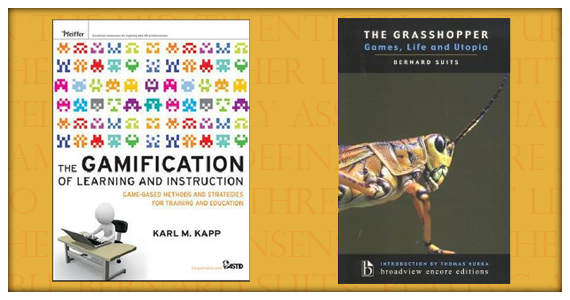
The gamification of learning and instruction by Karl M. Kapp (link)

The Grasshooper by Bernard Suits (link)

quarta-feira, 1 de fevereiro de 2012

Experience – part II

By Vince Vader

I really enjoyed writing my last post (link here) about experience of players inside the games. So I've decided to write a little bit more about this fascinating subject. In this post I want to highlight some ideas to complete this thought.

I think there are three great aspects that help us understand the involvement of the players with the game universe: the idea of a labyrinth, the concept of virtual presence and the concept of flow.

I like to use the idea of a labyrinth of games as a metaphor. I think it's important to offer the player a chance to get lost inside the game world. But it's very important to offer this as a challenge to be completed and not as a bad sensation that leads the player to nowhere. As Kerényi wrote, the concept of a labyrinth is possibly a cultural good of all humanity whose origins date back to the Stone Age (page 66) and possibly all the ludic activities results in a kind of maze (page 72). So we can conclude that the idea of a labyrinth is - in some way - a mythological heritage of us all.

Continuing the thought, it's important to study the concept of "presence" inside the game world. Offer the player a labyrinthine environment is easy but the great challenge is to put a virtual presence of the player into the game (using narrative resources, coherent game mechanics, good graphics, etc.).

Nitsche (page 203) in reference to Slater (1993) talks about forms of presence and argues that “presence” is understood as the mental state where a user subjectively feels present within a video game space as the result of an immersion into the content of the fictional world. It is a mental phenomenon based on a perceptual illusion. In reference to Lombard and Diltron (1997) Nitsche (page 203) says that a great number of researchers have concentrated on the idea that a state of presence should be connected to the illusion of a nonmediated experience. In this case, players do not see the interface anymore because they feel present in the world beyond the screen.

The last concept I want to discuss is “flow”. I’ll go back again to the author Michael Nitsche to complete this thought. Nitsche (page 204) citing Csikszentmihalyi (1991) says that “flow” has been introduced as a state in which a person is fully immersed in an action and highly focused to the extent that one can experience, for example,

a loss in the feeling of self-consciousness and time experience. A player who reaches this level is clearly immersed in the game but not necessarily “present” in the virtual space.

All these features help us to create good experiences involving games.

In a future post I want to discuss some ways to generate the idea of a labyrinth and the concepts of presence and flow. Szia!


References:

CSIKSENTMIHALYI, Mihaly. Flow: the psychology of optimal experience. New York: Perennial (HarperCollins), 1991.

KERÉNYI, Karl. En El laberinto. Madrid: Ediciones Siruela, 2006.

LOMBARD, Matthew & DITTON Theresa. At the heart of it all: the concept of telepresence. Journal of Computer-Mediated Communication 3, no. 2 (1997): 1-39.

NITSCHE, Michael. VIDEO GAME SPACES - image, play and structure in 3Dnworlds. Massachusetts: MIT Press, 2008

segunda-feira, 28 de novembro de 2011

Essential books about game design & gaming concepts - EPISODE III

Another six good books from my particular game design library to complement the first and the second posts of this subject. In the end of each topic of this post there´s a link to Google Books with previews.

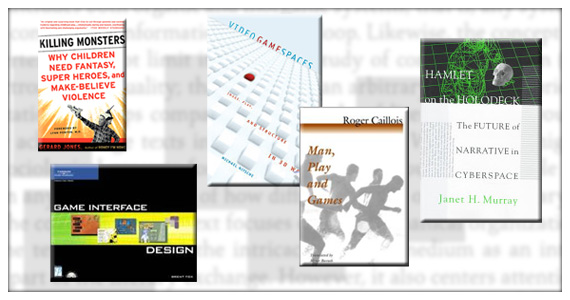
Hamlet on the holodeck: the future of narrative in cyberspace by Janet Horowitz Murray (link)

Game interface design by Brent Fox (link)

Killing monsters: why children need fantasy, super heroes, and make-believe violence by Gerard Jones (link)

Man, play, and games by Roger Caillois (link)

Imagination and Play in the Electronic Age by Dorothy G. Singer, Jerome L. Singer (link)

Video game spaces: image, play, and structure in 3D game worlds by Michael Nitsche (link)

quinta-feira, 27 de outubro de 2011

Jesper Juul

Jesper Juul is a video game theorist and assistant professor in video game theory and design at the Centre for Computer Game Research Copenhagen where he also earned his PhD. His book Half-Real on video game theory was published by MIT Press in 2005. Additionally, he works as a multi-user chat systems and casual game developer. In the video below you can see Jesper talking a little bit about his book, games, game design and gaming concepts:

video platformvideo managementvideo solutionsvideo player

He is one of my favorite authors and his book "Half-Real: Video Games between Real Rules and Fictional Worlds" has some excellent insights that I´ve used a lot in my classes in this year. Two quotes from this book that I want to highlight here are:

To play a video game is therefore to interact with real rules while imagining a fictional world, and a video game is a set of rules as well as a fictional world”.

These are the two things that video games are made of: real rules and fictional worlds”.

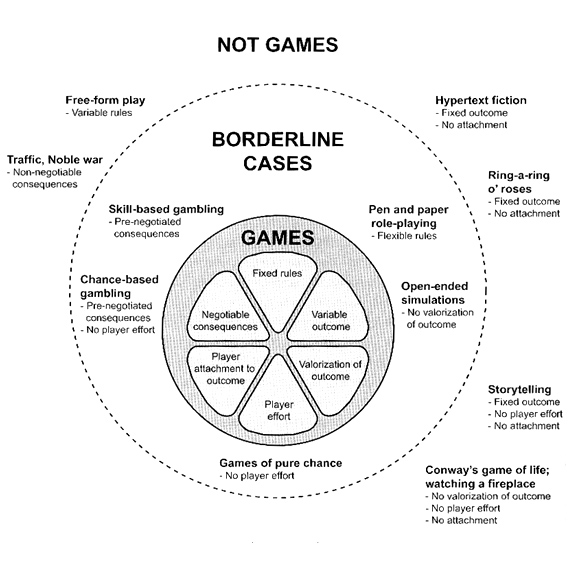
And I want to share an excellent diagram about the universe of the games from this book too:

And for last I want to leave a very interesting link from Jesper Juul´s site: its a "Dictionary of Video Game Theory". Click here to go to the URL.

Enjoy!


Reference:
JUUL, Jesper. Half-Real: Video Games between Real Rules and Fictional Worlds. USA: MIT Press, 2005.