Mostrando postagens com marcador hints. Mostrar todas as postagens

segunda-feira, 1 de fevereiro de 2021

Eight solo game developer mistakes to avoid

Another excellent video with brilliant ideas from Ask Gamedev YouTube channel.


Eight Solo Game Developer Mistakes to Avoid:

1.Lack of feedback
2.Lack of demo build
3.No source control
4.Coding standards
5.Custom engine
6.Bad art
7.No test plan
8.Not finishing

#GoGamers

sexta-feira, 4 de outubro de 2019

Ten ideas from Reiner Knizia about playtesting

Reiner Knizia is one of the biggest names in game design around the world. The German game designer is a mathematician and has his name associated to more than 700 games launched in many different countries. I had the honor to talk personally to Knizia in 2011, at DIGRA’s conference in Hilversun (Netherlands) and I watched a great keynote about the game designing process in the same event.


On that occasion, I gave Knizia my board game, YN, and had the opportunity to talk a little bit with him (a great achievement for my game designer career).


I follow Knizia in social media and I’m always taking notes about the knowledge on game design he shares on those platforms. In this post, I will reproduce 10 ideas Knizia showed recently on Twitter about playtesting (one of the most fundamental topics in the game designing process). Below, I listed the 10 points. Follow him by clicking here.

Playtesting 1. Those who do not play do not live. Those who do not playtest do not design.

Playtesting 2. Designs always work perfectly in your mind. The first playtest is the (often cruel) moment of truth.

Playtesting 3. Regardless of how much experience you have, you cannot develop a game on the drawing board – only at the playing table.

Playtesting 4. Game design is a classic iterative process of playing and improving – nowadays popularised as “design thinking”.

Playtesting 5. When your playtesters do not like your design, (usually) your design is to blame – not your playtesters.

Playtesting 6. I recognise good playtesters by my (frequent) urge to strangle them.

Playtesting 7. For your design to appeal to one group, test with one group. For your design to have broad appeal, test with many groups.

Playtesting 8. You can make (most) designs interesting through your play-talk - but when published, your design needs to speak for itself.

Playtesting 9. Blind playtesting, without you taking part, is as useful as other people going on a rollercoaster and reporting their experience.

Playtesting 10. When you have playtested your design to perfection, let it rest some time, then play again. – Expect to be surprised!

#GoGamers

segunda-feira, 7 de maio de 2012

Hints & tips for a good game prototype – Part I (card game)

By Vince

A good idea for a game needs a good prototype. In the first tests of your game is totally understandable the use of sketches, roughs and non-finished materials, but a formal presentation to a publisher needs more care.

In this post I´ll talk about analogical prototype. More precisely how to create a card game prototype.

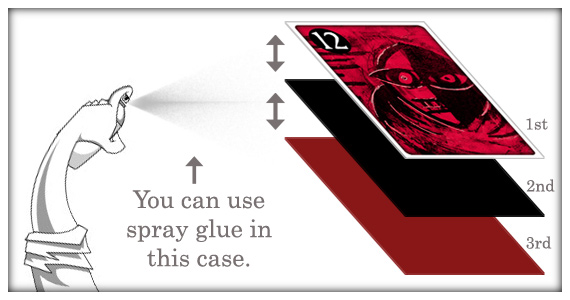
I like to create cards in three layers of paper:

1) First layer: the back from the card (with some kind of pattern or the logotype of the game) printed with laser jet in a good opaque paper;
2) Second layer: I like to put a middle layer using a thick paper. It’s important to maintain your card resistant and plain;
3) Third layer: the front of the card with the content of the game in the same way of the first layer.

Check the diagram below:


In the end it’s important to keep your cards protected from physical damage. I strongly recommend putting the cards inside plastic protector sleeves.

Your game will look more professional and your idea certainly will be clearer to the publisher or your beta test group.

Szia.