Mostrando postagens com marcador interface. Mostrar todas as postagens

terça-feira, 6 de agosto de 2024

What makes a Heads Up Display (HUD) a good feature in a game

A Heads-Up Display (HUD) is a crucial element in modern video games, providing players with essential information that enhances their gameplay experience. A well-designed HUD seamlessly integrates into the game world, offering clear and concise data without overwhelming the player. Effective HUDs balance aesthetics with functionality, ensuring that vital information is easily accessible at a glance. For example, a health bar that is both visually appealing and clearly indicates the player's condition is essential for survival-based games.


Beyond basic information such as health and ammo, a good HUD can also provide contextual cues that aid players in making informed decisions. For instance, a minimap that highlights objectives or enemy positions can significantly improve a player's strategic thinking. Additionally, HUD elements can be dynamically adjusted to suit different playstyles or game modes. For example, a stealth-focused game might prioritize a HUD that displays noise levels or enemy detection ranges, while a fast-paced action game might focus on displaying cooldowns for abilities.

Ultimately, a well-executed HUD is an invisible yet indispensable tool that can elevate a game from good to great. By providing players with the information they need without distracting from the core gameplay experience, HUDs can enhance immersion, improve decision-making, and contribute to a more satisfying gaming experience.

#GoGamers

domingo, 4 de novembro de 2018

Three gaming interfaces to pay attention to

In this post, I want to discuss some gaming interfaces and user experience features in games. I will use my three favorite games for this present post, but the subject is broader and allows a bigger discussion that I intend to return to, next month.

DEAD SPACE (PS3)

In the horror-fiction game Dead Space, the interface is something to pay special attention to. The character’s (Isaac Clarke) main statuses are disposed in a very strategic way: the life meter is located on his back in the shape of a spinal light, the weapon ammunition is showed as a small number when you aim the gun and, finally, the game has an interesting resource that is a luminous laser to help you easily locate the way the character must go (and it saves time in the complex scenario maze).


HERO (Atari)

This one is a relic from the beginning of the video-gaming era. HERO is an interesting case of user experience (UX) and interface with very limited constrols. Atari’s joystick has only one button and one directional stick; with only two resources, HERO’s designers implemented a wide range of possibilities: when you press the red button in the joystick the character uses its laser vision to kill enemies; by pressing down the control stick the character launches a dynamite do open walls and, finally, when you hold the control stick up the character flies using a jetpack. A very rich interface and UX created using minimal resources.


Entwined (PS4)

One of my favorite indie games Entwined is a great case of interface and usability. All the gameplay is based on how you can manage the two control sticks from PlayStation’s joystick. During the whole experience, you must control the two mystic entities by only using circular movements; the user experience is focused on coordinating two different positions simultaneously (a challenge to your dexterity). Entwined is an incredibly created game, using only circular movements in two control sticks, a master class of game design.


On the three cases related in the post, we can clearly see the ideas of how games must strategically use concepts from the user experience field. To finish this conversation I want to share some content from the site nForm about this subject:

The user experience is not one simple action – it is an interconnected cycle of attempting to satisfy hopes, dreams, needs and desires. This takes the shape of individuals comparing their expectations to the outcomes generated by their interaction with a system. Managing expectations then becomes key to successfully providing a satisfying “return on experience” that delights users and generates shared, sustainable value”.

#GoGamers

quarta-feira, 10 de dezembro de 2014

More about gaming interface

Much is said about interface in games today. After a long winter, producers and game designers discovered that a merely beautiful game does not work as product nor as a good experience to different kinds of players.

Try to imagine this situation: a beautiful futuristic game fulfilled of great cut scenes and technological characters. Everything in the scenario is perfect, but every action is a mystery for the player inside this fictional universe. It’s difficult to understand where you need to go, when the objective is accomplished, and it’s impossible to determine what kind of object you can take from the ambient.


Schell (2008, p.222) says in his book The Art of Game Design that the goal of a good gaming interface “isn’t ‘to look nice’ or ‘to be fluid’, although those are nice qualities; the goal of an interface is to make players feel in control of their experience.

Complementing Schell’s ideas, Perron and Wolf (2009, p.66) postulate that one of the “fundamental conditions that govern our interactions with video game virtual environments is that our actions are mapped onto the game system by various technological means, since we cannot physically manipulate the virtual entities directly”. By this last quotation we can understand the importance of a good interface and how it can create an immersive experience to the audience.


An interface establishes an answer system between the game and the player. Before we think about fantastic graphics, it is more important to design the interface to create a deeper experience. For more information and to discover more about this theme, I strongly recommend the following readings.


References:

PERRON, Bernard; WOLF, Mark. The Video Game Theory Reader 2. New York: Routledge, 2009.

SCHELL, Jesse. The art of game design. Burlington: Elsevier, 2008.

quarta-feira, 11 de junho de 2014

Duet

A few weeks ago I downloaded a very elegant game in my mobile phone: Duet. The game is a minimal and hypnotic experience created with a simple interface and high level of involvement. It is an invitation to “expand the limits of your radial awareness”.


The game comes from an Australian publisher named Kumobius and the composer Tim Shiel signs the awesome soundtrack. The idea is very simple: you press the right side of the screen, two small balls spin to the right; you press the left side of the screen, they spin to the left. With these two simple movements you must dodge elements that fall from above. Check the gameplay below to understand the main idea:


The game has a complex learning curve with a real challenge in the high levels. This kind of experience tells us about how a casual game could be a challenge even for hardcore players. And, in this scenario, we can see how rich the field for good ideas to mobile media is.

Another point to highlight on Duet is the simplicity of the interface. With few elements, the game conveys an engaging idea and a perfect ballet between aesthetics and gameplay. About that, it’s possible to say that “Gameplay must take place somewhere, and so the design and creation of digital environments is a critical factor in developing outstanding games. (…) Designing game spaces comes in two distinct parts – the first is the look and feel of the game environment, and the second is the design and challenge of the playing space” (THOMPSON; BERBANK-GREEN; CUSWORTH: 2007: p.98).

Let’s discuss more and more about this emerging category of the gaming industry.


Reference:

THOMPSON, Jim; BERBANK-GREEN, Barnaby; CUSWORTH, Nic. Game Design: principles, practice, and tecniques - the ultimate guide for the aspiring game designer. New Jersey: Wiley, 2007

quarta-feira, 12 de junho de 2013

Immersion, image & games

Last week we had the announcement of the new Microsoft's console, Xbox One. Few weeks ago we saw the presentation of the Playstation 4 and Nintendo launched the Wii U in the beginning of the year. The new generation of video games is here and gamers are curious about the enormous possibilities of this new communicational ecosystem. Undoubtedly, the graphics are one important piece to analyze in this process.

What I want to highlight in this discussion is the evolution of graphics on video games, since the first electronic games until today. We had a great leap from the first textual games (like Zork) to the modern first person shooters (like Call of Dutty).

Graphics on video games are important pieces to a player’s immersion. And I’m not talking about realistic graphics only, because all we know that an abstract game like Tetris could create a strong immersion in the players. A textual game could be immersive too, but it seems that images can be more determinant in this complex act.


As Aarseth remembers (1997, p.102) “images, specially moving images, are more powerful representations of spatial relations than texts, and therefore this migration from text to graphics is natural and inevitable”.

I think it’s possible to say that the main object of the graphics on a game is to be a kind of “bridge” or “portal” to the immersion. A kind of facilitator/translator to the player to get totally inside the game interface.

As Nitsche says (2008, p.44) “evocative narrative elements encourage players to project meaning onto events, objects, and spaces in game worlds. They help to infuse significance. Their value is not realized on the level of the element itself but in the way players read and connect them. Creating these connections, players can form narratives that refer to the game world. If this meaning assignment becomes very strong, the virtual items themselves can leave the rule-based space, fictional space, social space, and even the play space”.

In a world full of possibilities of connections and full of screens all around it’s important to study ways to create better immersion process to our players.

Now on to your opinion.


References:

AARSETH, Espen. Cibertext: Perspectives on Ergodic Literature. The Johns Hopkins University Press: Maryland, 1997.

NITSCHE, Michael. VIDEO GAME SPACES: image, play and structure in 3Dnworlds. Massachusetts: MIT Press, 2008

quarta-feira, 4 de julho de 2012

Game interface

Here comes some good quotes from the book Game Interface Design. I believe they are essential ideas to assist the process of creating games. Let's check these points.


Even more important than the visual aspect of interface design is the funcionality. A poor interface can ruin the entire video game experience. The game experience will be negative if the user is confused and can't figure out how to navigate the front-end menu or if he can't understand where to find information while playing the game. (page 2)

Interface planning helps game design. A detailed plan for a video game interface can really help drive game design. Fleshing out all of the details in the menus and the HUD (heads-up display) will force many game-lay decisions to be made early. (page 10)

Simplicity and organization should still be your design goal. The user will enjoy being able to look at a screen and instantly know what to do. Keep your design simple. (page 69)


REFERENCE
:

FOX, Brent. Game interface design. Boston: Thomson Course Technology, 2005.

terça-feira, 5 de junho de 2012

More about ludic interfaces

By Vince

BORJOMI, a georgian mineral water, launched a few weeks ago an awesome site with a great ludic interface. The creative team of the site found a very clever way to talk about the main feature of the product.


The mineral water has a curious differential: its source lays under 8 kilometers from the surface, so the water has a high level of purity.

There was a great challenge in this case and the solution for this advertising piece was not so obvious, but the creative team had a great idea: to create the deepest site of the internet.

They created a site that allows the user to scroll the screen for (real) eight kilometers. Looks weird, but it is true and you can check this on the URL http://thedeepestsite.com/ and on the video below.


If you have patience to "dig" the screen to the end, you will find the mysterious and pure source of water BORJOMI. As a prize you can write your name in a kind of hall of fame and tell the fact in your Facebook timeline to your friends.

An important feature of the site: anytime you want, it's possible to save your progress by using your Facebook login and password.

The BORJOMI's site is an excellent example of ludic interface. It is not a game, but it uses characteristics of games as "save", "badges", "ranking" and "mechanics" to promote a brand. This case shows us that is possible to put ludicity in many differents aspects of advertising and marketing.

I want to bring more gaming advertising cases to the blog. Wait for news.

Szia!

sábado, 2 de junho de 2012

Video game origins

By Vince

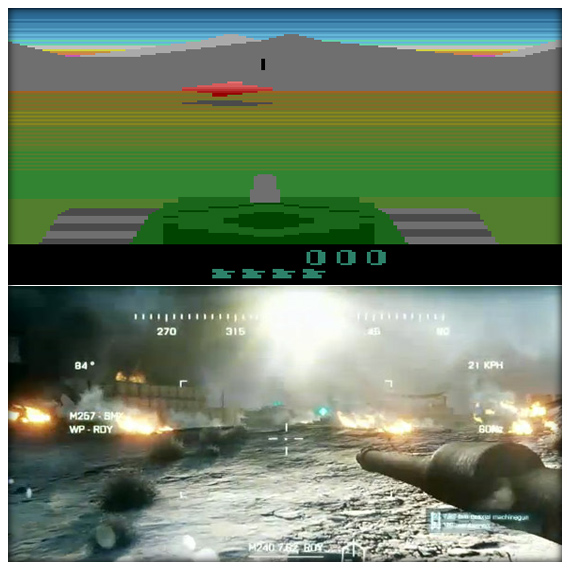
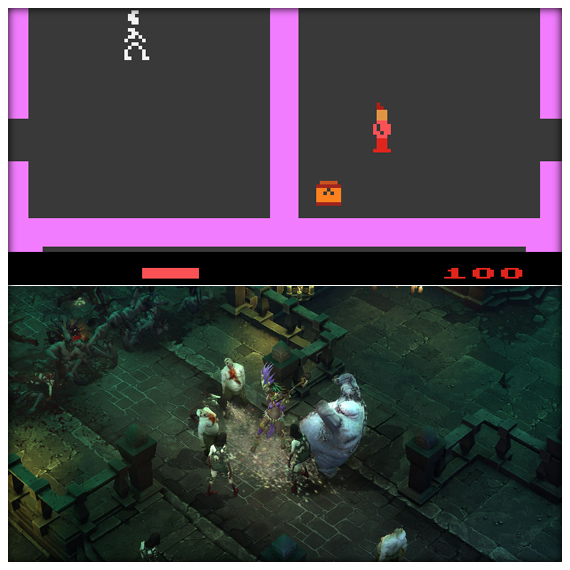
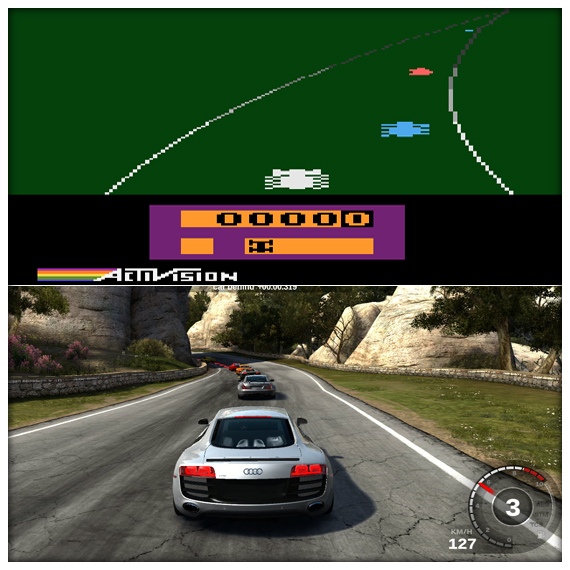
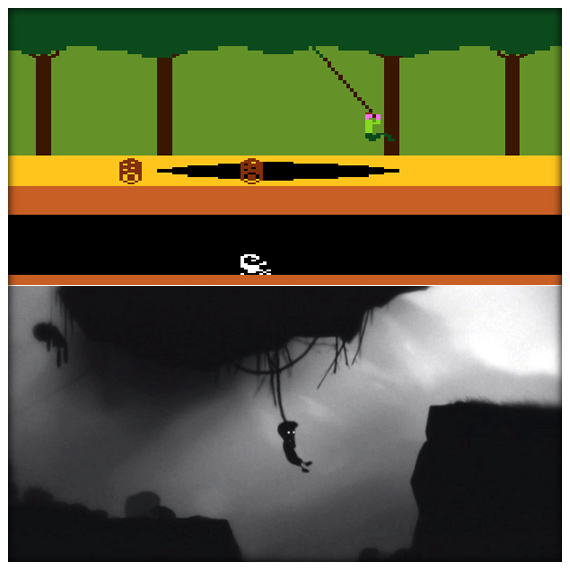
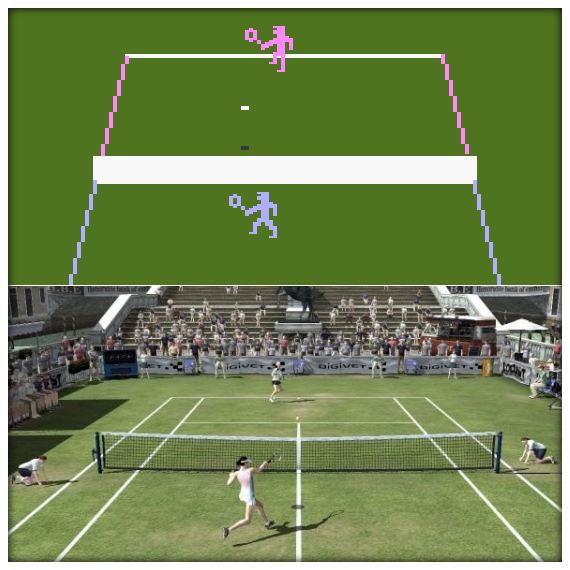
A long time ago, in the beggining of the 80's started a great video game revolution with the Atari system.

A lot of titles from this time became the first inspiration for modern genres.

It's possible to see the first insights for FPSs and RPGs in these primitive interfaces.

Let's check some curious examples:


Battle Zone X Battlefield 3


Dark Chambers X Diablo 3


Enduro X Forza


Pitfall X Limbo


Tennis X Virtua Tennis 3

It's possible to create a huge list. Send suggestions and enjoy!

Szia!